FHU’s Engaged Learning Initiative (ELI) is a program dedicated to enhancing the academic experience of the FHU undergraduate student. The ELI connects the classroom with the real world – from theory to applied practice. Our ELI develops practical knowledge and skills, so that students are better prepared for future educational and career goals.
Through the ELI students will:

Institutional grants are available to fund student and faculty ELI projects in five categories. A detailed description of each category and examples of projects are found in the Best Practices for Student Engagement Faculty Guide.
Download the Best Practices for Student Engagement Faculty Guide
Download the ELI Special Project Proposal Form
Download the ELI Special Project Rubric
Submit ELI Special Project Proposals to eli@fhu.bramblettgrp.com. The proposal deadline for projects to be funded for the following academic year is April 1.
The investigator will work to make a novel, meaningful contribution to a discipline-specific question or idea.
A systematic pursuit of knowledge is essential to academic life. Academic research provides a means by which we can engage the world and seek understanding. Often through research, ideas are challenged, beliefs are revised, and meaningful growth occurs. By conducting research, investigators have an opportunity to independently investigate topics while also increasing overall knowledge in a particular field. The goals of specific research projects will vary, but it is expected that by conducting research students will:
A proposal for a special project must involve sharing research results through publication or presentation to an interested audience (class, campus or conference) and include a reflective component about opportunities and/or challenges of the project. Two examples include conducting research off campus through internships and participating in collaborative projects between faculty and students outside of normal research group activities.
The student will explore the creative impulse through the design, execution and display of a work of art. Working individually or with a larger group, the student will create a work of visual, musical, theatrical or literary art for public viewing.
The visual, performing and literary arts provide an outlet for students to explore the process of creativity. As children of a Creator God, all people possess some capacity for either the appreciation or creation of artistic work. Students will explore the arts’ conceptual framework and expressive process in the execution of an original work or in the interpretation of an artist’s original work. Interpretative work takes place when the student explores the work of playwrights, composers, choreographers or authors embodying these works with a larger company or alone.
All Creative Expression endeavors must:
The project must contain a significant experiential activity and reflective writing component. Special projects may include, but are not limited to the following: a summer performance with a professional theatre, performance with a regional symphony orchestra, touring with a band, showing original art in a regional gallery, publishing a work of fiction, and travel to gain inspiration and broaden perspective needed for the creative process.
Participants will actively engage with people from cultures other than their own through travel, service opportunities, missions or other study opportunities with the goal of increased cultural empathy and expansion of their perspectives of ethical responsibility, humane values and social justice.
Global citizenship education inspires dialogue, action, partnerships and cooperation through formal and informal education processes. It is a multifaceted approach employing various methods to promote human rights, peace, justice and sustainable national and international relationships and resources. Its ethos is shared responsibility.
We are members of many communities: our churches, our campus, our local community, our state, our nation and our world. As such, we have an opportunity to understand and appreciate the differences between people from cultures other than our own and the interconnection between cultures. This understanding and appreciation, in turn, should lead us to an awareness of our social responsibility to those in all the communities we are members of. As Christians, we have a special calling to be engaged as global citizens; a part of our Christian mission is to care for others, meeting temporal needs, as well as spiritual needs.
The goal is to move toward an understanding that being a global citizen involves an ongoing process of development (learning and growth). The most important elements in the development of global citizenship is the constructive engagements with those who are different; opportunities to pursue social avenues that advance human rights; and discussions with peers, faculty and diverse community or international groups.
The project should stimulate cultural empathy gained through interaction with community, national or internationally diverse groups. The project must contain a significant experiential activity and reflective writing component. Examples include, but are not limited to the following: a mission trip experience, an activity that requires interactions with and service to members of a different community, and internship experience in a foreign or diverse culture.
The student will explore and experience leadership from a servant–first perspective.
Individuals that chose to participate in this category will be exposed to experiences and activities designed to expand the traditional role and practice of leadership. A leader that develops through this program should strive to be a servant first, as modeled by our Lord Jesus Christ. Participants in this program area will be exposed to leaders and leadership concepts that exhibit the servant leadership model and identify how the areas of service and leadership can coexist in them and their vocation. The project must substantially explore or develop two or more of the following characteristics of servant leadership:
Special projects shall have a substantial leadership component and address two or more of the servant leadership elements above. The developers of the project will need to demonstrate in the proposal how the project will be considered for servant leadership credit by linking the project to the traits and characteristics of servant leaders. A student project requires a minimum of 120 hours of involvement and must have an academic sponsor. In addition to the reflective writing component, the student must keep a journal and a log of activities throughout the duration of the project. Examples include the following: mission trip organizer and leader, service project coordinator and undergraduate research team leader.
Participants will actively engage in a professional development experience.
Participants will use this opportunity to further enhance their scholarly pursuits through internships, practicums and other opportunities to work alongside professionals or in professional settings.
The Bridge Experience provides students and faculty opportunities to cultivate and enhance talents related to their specific professional fields of interest. The opportunities provided through the Bridge Experience will also serve to build, or bridge, relationships among the distinct colleges of the university with the professional communities at large.
Swipe tab to advance content

In the summer of 2023, Senior CSD major Elizabeth Roberts spurred an engaged learning initiative with classmates from other majors to find ways that our students can interprofessionally learn about healthcare and culture through vocational formation as Christians. Mary Katherine Walker (biology), Zachary Roberts (nursing), and Dalton Shumate (psychology) explored the origins of western medicine, universal healthcare systems, & diversity & religiosity in care with Dr. Meagan Spencer as their sponsor. The group spent 10 days between Nashville and London engaging with various hospitals, attending special lectures, and visiting sites that stage our conceptualization of patient care.
It’s not every day that you get to go to a lecture in Westminster Abbey to attend a lecture by Professor Anthony Reddie, Director of the Oxford Centre for Religion discussing Christianity and culture in Black Lives Matter or a seminar by Dr. David Antcliffe, professor at the Imperial College at Chelsea & Westminster Hospital’s ICU unit on new sepsis treatment research.
Patient care is everybody care and while not a healthcare major, Mary Katherine Walker, was intrigued how her studies fit into the narrative while learning about plant constructs & the culture of modern medication at the Chelsea Physics Garden.
Zachary Roberts stated that, “this trip extended to me the opportunity to learn more about the medical ethics, intrinsic religious care styles, and general healthcare principles of London compared to the U.S. The largest differences to me were the ethics in the UK compared to ours. We specifically learned about ethics in testing new medications for sepsis. We saw how in the U.S., the healthcare styles are intrinsically Christian in the core values of caring for patients as equal human beings, and how patient care is everyone’s job. We saw the difference of national healthcare style in the UK compares to U.S. healthcare, and how that affects the quality of care given, and waiting times in emergency rooms. We attended an event at King’s College at which we learned more about other countries healthcare. My personal favorite part about the trip was visiting the Florence Nightingale Museum and learning about the early roots of nursing.”
While discussing leadership, clinic services, and how dynamic teams work together in the US system with Dickson Community Clinic, TriStar Horizon Medical Center, TriStar Skyline Medical, Tristar Natchez, and Harris & Frazier Lobbying Firm, Dalton Shumate started to mold his own career interests by seeing how mental health is a powerful tool in the dying art of general practice and he might like to pursue a career in community care.
All of these students saw the power of the spiritual gifts of serving others in vocation and how they can influence the future of service and research.
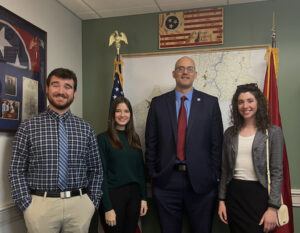
A group of eight Freed-Hardeman University Communication Sciences and Disorders majors had the opportunity to travel to New Orleans, Louisiana to attend the National American-Speech-Language-Hearing Association (ASHA) Conference. While at the conference, the students were exposed to various ASHA speakers, exhibits, and discussion that highlighted recent advancements in the field to which they are studying to practice. The students participated in session debriefs, in which critical analysis of how early exposure to careers, graduate education, and research at the undergraduate level influences their program of study.Networking and research were two primary goals for the students that were fulfilled through participation in a Career Fair and Graduate School Fair. While at the Career Fair, each student received assistance in creating a resume and spoke with an array of prospective employers. The Graduate School Fair allowed the students to research various graduate and/or PhD programs to learn more about their program goals, curricula, clinical experiences, and research opportunities. Each student left the conference with a network map of professionals from across the nation that will enable them to advance their future education and career goals.
As part of their obligations to attend the ASHA conference, the students will conduct presentations at FHU’s 2024 Scholar’s Day, as well as, at the Tennessee Association of Audiologists and Speech-Language Pathologists convention.
Faculty: How did you see your students grow or change?
Meagan Spencer: Most of these students had never been to a large city outside of Nashville, so it was neat to see them grow both personally and professionally. They learned how to navigate, street safety, and talking with researchers and professionals on their own. They were very tired, but very excited at the end of each day. We would have dinner and do a round table to share the day’s sessions and activities reports. This activity further encouraged our students to participate in some of our state level research and advocacy activities such as helping pass a new occupation license bill in Tennessee, exploring research in the honors college and other ELI opportunities, and pursuing some of the graduate schools to which they applied.
Students: How did participating in the project benefit you?
Elizabeth Roberts: We got to see all the different job opportunities for SLPs and audiologists and speak with different companies about them. I really liked hearing about various experiences that people have had in their careers and even in grad school. Going to the sessions was interesting because we had not been exposed yet to some of the advanced practice techniques and it was exciting to learn about additional skills and certifications. New Orleans is a lot different than Henderson. I had never been and learning to navigate a city and new culture was interesting.
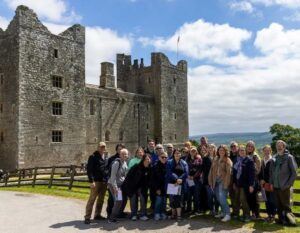
In the summer of 2022, Dr. Margaret Payne, Molly Clemons, and Rose Duke explored the literature, landscape and architecture of Romantic England. Their adventures were in connection with Dr. John Mclaughlin’s Spring 2022 Romantic Poetry and Pose class. The group of 22 spent two weeks exploring England through hikes and various tours through famous writers’ homes.
Student Rose Duke prepared for the trip through extensive readings surrounding the foundational Gothic novels written during the romantic period. Her focus was to explore ways that the Romantics’ use of the Neo-Gothic intersected with theories of ecocriticism to further expand on how writers such as Wordsworth, Coleridge, Keats, Austen, and the Shelleys used their surroundings to fortify the works they created. While visiting England, she captured a visual rendering of Neo-gothic architecture and its ties to literature by documenting the experience through a reflective and descriptive photo journal.
English major Molly Clemons embarked on the journey to examine the unique relationship between the writings of William and Dorothy Wordsworth and the nature of William’s poems in relation to Dorothy’s journal entries. Following this experience, Molly further her studies by completing an independent studies on Jane Austen and Dorothy Wordsworth.
Dr. Payne’s embarked on this adventure with her students to continue her extensive research into women authors on ritual in women’s literature.
As a part of the travel, the team visited the following:
Both Molly and Rose presented their projects during FHU’s Scholars Day in fall 2022.
Dr. Payne has used her new found knowledge and experiences to enrich her classes by exposing students to new ideas, text, photos, descriptions, and stories through class discussions and lectures.
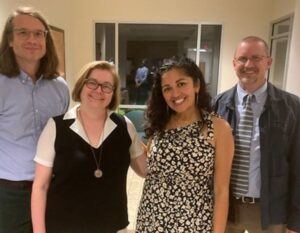
In the fall 2022 semester, FHU students had the opportunity to interact with the celebrated author and poet Aimee Nezhukumatathil who gave an evening talk to the campus and community and provided a poetry workshop for English majors and poetry contest winners in the afternoon. There were several goals of this project, the first being the exposure of FHU students to a nationally acclaimed author. Other goals included the formation cross-disciplinary discussion of the themes and issues connected to the poet’s work, to provide writing students with a poetry workshop with a renowned poet, to shape discussions in Comp I and Comp II classes, and to provide a focus on the wonders of God’s creation and an attention to our responsibilities to the environment. As a result, this project had a direct connection to at least 300 FHU students (including students in ENG 101 and 102—on campus and dual enrollment students, students in Creative Writing, honors students, and those from a number of science classes. Ayers auditorium was filled for the evening session, 17 students attended the poetry workshop, and roughly 150 students engaged in discussions and writing projects in ENG 101 and 102. Two Professors on Poetry sessions were conducted in connection with this project including one that featured interplay between English and science faculty members; that event was attended by roughly 25 students.
This project resulted in a number of outcomes:
Overall, this project was an incredible experience for FHU students. The author remained after the public talk until every book was signed. She posed for selfies for every student (and faculty member) who asked. She engaged them in conversation and replied to their social media posts. The conversations of the night were wide ranging and included family, race/ethnicity, writing, nature, and happiness. Our students asked intelligent questions and were granted exciting answers and interplay in response.