The Freed-Hardeman Undergraduate Research Experience was created to provide an arena that fosters undergraduate research in a well-equipped laboratory facility for students and faculty in their collaborative pursuit of innovative solutions to the myriad of scientific challenges faced in today’s technologically advanced world.

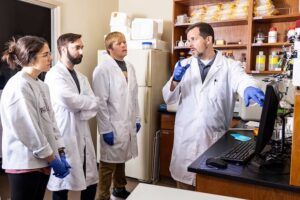
In the fall of 2005, the Research Center was founded for the purpose of engaging undergraduates in scientific research. In the fall of 2012, the Anderson Science Center was completed and opened for classes and research. The lab facilities housed in the old Research Center were moved to the state-of-the-art laboratories within the Anderson Science Center. The Research Center was then renamed the Freed-Hardeman Undergraduate Research Experience to better reflect the scope of scientific research occurring on campus. Starting in the summer of 2022, the Biochemical and Biomedical Sciences Summer Research Program began as a 6-week summer experience on the campus of FHU utilizing the labs in Anderson.
Students at FHU engage in research projects under the direction of mentors in several areas of science. Much like graduate level research, our students write procedures, run experiments, collect data, analyze results, propose alternate methods, present their work at conferences, and help write manuscripts for publication. Faculty mentors include our chemistry and biology faculty.
FHU students have the opportunity to engage in research starting their freshman year. Students are introduced to the faculty early in the fall semester and learn about the various research projects and opportunities during a research-focused chapel session. Research is becoming increasingly expected of students who want to study at the graduate and professional level. Student researchers include those in pre-medicine, pre-pharmacy, pre-dentistry, as well as those interested in pursuing graduate school (PhD) in the sciences. FHU graduates who have benefitted from research experiences can be found across the health professions in addition to research, teaching, and other avenues for the application of their science training. Since the summer of 2022, students have had the opportunity to engage in the Biochemical and Biomedical Sciences Summer Research Program
Anderson Science Center houses research and teaching spaces for disciplines across the range from biochemistry and chemistry to biology, ecology, anatomy and physiology, and microbiology. Research equipment includes multimode plate readers, gel imaging system, PCR and RT-PCR thermocyclers, high-speed centrifugation, GC-MS, HPLC, Oxford Nanopore DNA sequencers, and many other resources.
We’re excited to invite you into the Freed-Hardeman community. What’s next? Once you have been admitted and made the decision to attend Freed-Hardeman University, it is time to reserve your place in our incoming class by paying your Enrollment Pledge.
Amphibians and reptiles are vertebrate groups that are facing a variety of environmental pressures. To comprehensively address conservation issues impacting amphibians and reptiles, an understanding of the basic natural history and ecology of species within these groups is vital. Our research includes determining the geographic distributions and life history traits of amphibians and reptiles in West Tennessee. Currently, we are focusing our efforts exploring characteristics of the turtle communities on FHU’s campus and Horse Creek Wildlife Sanctuary, and the amphibian assemblage at Horse Creek Wildlife Sanctuary. We are also actively involved in turtle research with the Turtle Survival Alliance-North American Freshwater Turtle Research Group. We have 19 active study sites across the US and are also involved in a 10-year study in Belize.
Faculty involved:
Dr. Brian Butterfield is Professor of Biology and Dean of the College of Arts and Sciences. He is a graduate of Harding University (BS, Biology, 1985), Arkansas State University (MS, Biology, 1988), and Auburn University (PhD, Zoology, 1996). He has over 40 years of research experience in biology.
His work can be found:
Research Gate: https://www.researchgate.net/profile/Brian-Butterfield
Mr. Lee Barton is an Instructor of Biology. He is a graduate of Freed-Hardeman University (BA, Biology and Secondary Education, 2009), Freed-Hardeman University (M.Ed., Curriculum and Instruction, 2013), and Mississippi State University (MS, Biology, 2015). He has over 18 years of research experience in biology.
As part of an effort aimed at improving the aesthetics of Freed-Hardeman University, the establishment of arboretum certification is being pursued. The Tennessee Urban Forestry Council (TUFC) coordinates the arboretum certification program for the state of Tennessee. According to TUFC, the goal of arboretum certification is to, “expand the likelihood and ability of the public to see many varieties of trees; to discover their different names, appearances and uses; and to learn of the benefits that trees provide to our environment, our public, our communities, and our state.” TUFC has established four levels of certification, with level one being the beginning and level four being the highest. The identification of trees is a core requirement for the establishment of an arboretum. For a beginning level certification, thirty different species of trees must be identified. Both morphological and molecular identification techniques are being employed to achieve identification of a minimum of thirty trees across the campus of Freed-Hardeman University. Once identification is achieved, an arboretum trail containing the labeled trees will be established on campus.
Faculty involved:
Dr. Paul Fader is a Professor in the Department of Biological, Chemical, and Health Sciences where he teaches courses including Microbiology, Botany, and Biological Concepts of Origins among other courses. Dr. Fader earned his PhD at the University of Mississippi and has been teaching at FHU since 1993.
Dr. Caleb Kersey is a Professor in the Department of Biological, Physical and Human Sciences where he teaches a myriad of classes including Cell Biology, Genetics, and Microbiology. He graduated from FHU in 2005 (B.S. Biology) and from Tennessee State University in 2011 (Ph.D. Biological Sciences). He has been teaching and conducting research at Freed-Hardeman University since 2012.
Research Gate: https://www.researchgate.net/profile/Caleb-Kersey
Plasmonic nanoparticles are pivotal for their ability to enhance electric fields, enabling highly sensitive detection techniques such as Surface-Enhanced Raman Spectroscopy (SERS). These properties are especially relevant for detecting trace amounts of environmental contaminants, pathogens, or chemical molecules. Summaries highlight various innovations in nanoparticle design, including self-assembled vesicles, core-shell geometries, and nanomatryoshkas. These geometries optimize plasmonic hot-spots and enhance signal strength while ensuring stability and reproducibility.
Hydrophobic Contaminants Detection (2018): The development of a 3D SERS platform using amphiphilic gold nanoparticles tethered with block copolymers showcases its utility for ultrasensitive detection of hydrophobic molecules in environmental and food samples. This approach achieves picomolar sensitivity and demonstrates potential for rapid on-site testing.
Citation: Huang, X., Liu, Y., Barr, J., Song, J., He, Z., Wang, Y., Nie, Z., Xiong, Y., & Chen, X. (2018). Controllable self-assembled plasmonic vesicle-based three-dimensional SERS platform for picomolar detection of hydrophobic contaminants. Nanoscale, 10(27), 13202–13211. https://doi.org/10.1039/C8NR02778A
Magnetic Plasmonic Core-Shell Nanoparticles (2019): The study of non-spherical core-shell nanoparticles bridges magnetic separation and plasmonic enhancements, highlighting applications in drug delivery, imaging, and tumor therapy. It also validates the DDA method for non-spherical shapes, extending the scope of predictive models.
Citation: Bhardwaj, S., Barr, J., Chaffin, E., Huang, X., & Wang, Y. (2019). Near-field and far-field optical properties of magnetic plasmonic core-shell nanoparticles with non-spherical shapes: A discrete dipole approximation study. AIP Advances, 9(2), 025021. https://doi.org/10.1063/1.5087705
Coupling of Plasmonic Nanoparticles (2021): Investigations into near-field spectra of nanoparticle assemblies reveal complex coupling phenomena that affect SERS enhancement. The detailed analysis of plasmonic rulers and inter-particle coupling informs nanoscale distance measurement techniques and enhances understanding of plasmon hybridization
Citation: Barr, J. W., Gomrok, S., Chaffin, E., Huang, X., & Wang, Y. (2021). Insights on the coupling of plasmonic nanoparticles from near-field spectra determined via discrete dipole approximations. The Journal of Physical Chemistry C. https://doi.org/10.1021/acs.jpcc.1c01071
Gap-Enhanced Raman Tags (2023): The exploration of nanomatryoshkas with gap-enhanced configurations advances the field of biomedical sensing. These structures offer high sensitivity, stability, and protection for embedded Raman molecules, making them ideal for in vivo and in vitro applications, including cancer diagnostics and pathogen detection.
Citation: Eldridge, B. K., Gomrok, S., Barr, J. W., Chaffin, E. A., Fielding, L., Sachs, C., Stickels, K., Williams, P., & Wang, Y. (2023). An investigation on the use of Au@SiO2@Au nanomatryoshkas as gap-enhanced Raman tags. Nanomaterials, 13(21), 2893. https://doi.org/10.3390/nano13212893
Insights Using DDSCAT
The DDA-based studies, utilized by our group and executed by undergraduate research students, underscore the method’s precision in simulating optical properties of complex nanostructures. DDSCAT enables:
This computational approach is particularly critical in investigating near-field interactions, which are challenging to measure experimentally. By enabling accurate modeling of electric field distributions and coupling effects, DDA-based tools bridge theoretical and experimental gaps.
Broader Impact
These advancements in nanoparticle research have far-reaching implications. Improved sensitivity in environmental monitoring, real-time diagnostic capabilities, and enhanced understanding of nanoscale interactions mark significant strides in technology. Furthermore, these studies lay the groundwork for developing next-generation sensors and therapeutic agents, driving innovation across scientific and medical domains.
Faculty involved:
Dr. Jim Barr serves as an Assistant Professor of Chemistry, Chair of the Department of Biological, Chemical, and Health Sciences, and Director of Institutional Research and Analytics. His teaching portfolio spans diverse topics, from Coffee Chemistry and Physics to Chemical Kinetics and Thermodynamics. A 1999 graduate of FHU, Dr. Barr pursued graduate studies in chemistry and chemical physics at the University of Nevada, Reno, and the University of Memphis. Over the course of his academic career at multiple institutions, he has been involved in a wide range of research projects, including laser physics, molecular spectroscopy, photochemical molecular motor design, and nanoparticle plasmonics.
Soft rot disease of fruits and vegetables is caused by a group of gram-negative plant pathogenic bacteria that secrete plant cell wall degrading enzymes. The bacteria can reside in plant tissues until environmental conditions are suitable for the disease process to begin, after which there is little practical application for the elimination of these pathogens. While much is known about the enzymatic mechanisms of action that cause the rotting phenotype, the complex genetic regulation controlling enzymatic production has not been fully elucidated. In order to combat soft rot disease, a better understanding of the pathogenicity of soft rot bacteria is required.
Our current investigations involve the exploration of genetic mechanisms controlling a hypervirulent mutant in the soft rot bacterium Pectobacterium versatile.
Faculty Involved:
Dr. Caleb Kersey is a Professor in the Department of Biological, Physical and Human Sciences where he teaches a myriad of classes including Cell Biology, Genetics, and Microbiology. He graduated from FHU in 2005 (B.S. Biology) and from Tennessee State University in 2011 (Ph.D. Biological Sciences). He has been teaching and conducting research at Freed-Hardeman University since 2012.
Research Gate: https://www.researchgate.net/profile/Caleb-Kersey
Enzymology of Topoisomerases
DNA Topoisomerase II is among a diverse family of enzymes that maintain the topological state of DNA. In simple terms: these enzymes keep DNA from getting too tangled. Topoisomerases can temporarily break one or both strands of the DNA in order to untangle DNA or to keep DNA from becoming too supercoiled.
Our research involves using biochemical and bioinformatics methods to study the structure and function of the protein. How do different portions of the protein participate in reactions? What portions of the protein are critical for controlling function of the enzyme? These and other questions motivate what we do in studying topoisomerases.
We use a range of methods including recombinant protein expression and purification, protein gels, agarose gels, gel documentation and quantification, multimode plate reader analysis of protein and DNA concentration and purity, and other methods. We also utilize bioinformatics to study protein sequences in order to discover what portions of the sequences may be involved in different functions.
Our current work is focused on the end of topoisomerase II called the carboxy-terminal domain (CTD). This region is flexible and may take on different shapes depending upon what the enzyme is interacting with–whether protein, DNA, chromatin–and upon what post-translational modifications are present in the CTD. We aim to develop a model for the function of the CTD of topoisomerase II.
Relevant publications:
1. Dougherty, A.C., Hawaz, M.G., Hoang, K.G., Trac, J., Keck, J.M., Ayes, C., and Deweese, J.E. (2021) Exploration of the Role of the C-terminal Domain of Human DNA Topoisomerase IIa in Catalytic Activity. ACS Omega. http://doi.org/10.1021/acsomega.1c02083.
2. Endsley, C.E., Moore, K.A., Townsley, T.A., Durston, K.K., and Deweese, J.E. (2024) Bioinformatic Analysis of the C-terminal Domain of Topoisomerase IIa Reveals Interdomain Interdependencies and Critical C-Terminal Domain Interdependencies. Int. J. Mol. Sci. 25(11), 5674; https://www.mdpi.com/1422-0067/25/11/5674.
3. Hoang, K. G., Menzie, R. A., Rhoades, J. M., Fief, C. A., and Deweese, J. E. (2020) Reviewing the Modification, Interactions, and Regulation of the C-terminal Domain of Topoisomerase IIa: as a Prospect for future Therapeutic Targeting. EC Pharmacology & Toxicology, 8(6):27-43.
Utilization of Bioinformatic Machine Learning Tools to Examine Protein Sequences and Structures
Bioinformatic tools can be used to study protein sequences for various purposes. We have utilized a newly developed software tool called PSICalc (available here: https://github.com/jdeweeselab/PSICalc-viewer) to examine groups of protein sequences in order to find sequence interdependencies. Interdependencies are relationships between two or more sites in a protein sequence (or between two sequences). These relationships may be important structurally and/or functionally to the protein and can help researchers identify key sites in the protein.
In addition to PSICalc, tools such as AlphaFold are allowing researchers to explore protein structures and folding in cases where solved structures are unavailable. While the AlphaFold structures still require verification by other means, they can be useful tools for researchers. We are looking at ways to apply tools like AlphaFold to help predict the effects of mutations and explore proteins without known structures.
Relevant publications:
1. Endsley, C.E., Moore, K.A., Townsley, T.A., Durston, K.K., and Deweese, J.E. (2024) Bioinformatic Analysis of the C-terminal Domain of Topoisomerase IIa Reveals Interdomain Interdependencies and Critical C-Terminal Domain Interdependencies. Int. J. Mol. Sci. 25(11), 5674; https://www.mdpi.com/1422-0067/25/11/5674.
2. Townsley, T., Durston, K., Wilson, J.T., Akers, H., Cordova, S., Wallace, T.L., and Deweese, J.E. (2022) PSICalc: A Novel Approach to Identifying and Ranking Critical Non-proximal Interdependencies within the Overall Protein Structure. 2(1). https://doi.org/10.1093/bioadv/vbac058.
DNA Sequencing of aDNA
In recent years, numerous reports of soft tissue in fossils have been published indicating that proteins and other biological materials are present in some fossil materials. Recent advances in DNA sequencing technology have made low-cost sequencing resources available on a broad scale. This project utilizes Oxford Nanopore Technologies DNA Sequencing technology to sequence DNA fragments isolated from fossil samples. This DNA is often termed ancient DNA or aDNA. Initial proof of concept work has been completed and further studies are underway to develop methods for DNA extraction and preparation of DNA samples for sequencing and analysis. We are excited to collaborate with several labs around the US and the world on this project.
Faculty Involved:
Dr. Joe Deweese is Professor of Biochemistry and Director of Undergraduate Research at FHU. He is a graduate of FHU (BS, Biochemistry, 2004) and Vanderbilt University (PhD, Biochemistry, 2009). He has over 20 years of research experience in biochemistry and enzymology. He is also an Adjunct Associate Professor of Biochemistry at Vanderbilt University in Nashville, TN.
His work can be found:
Pubmed: https://pubmed.ncbi.nlm.nih.gov/?term=deweese+je&sort=date
Google Scholar: https://scholar.google.com/citations?hl=en&user=iXIZGWcAAAAJ
Research Gate: https://www.researchgate.net/profile/Joseph-Deweese
Github Code Repository: https://github.com/jdeweeselab
The Summer Research Program started in 2022 is a 6-week summer research experience held on the campus of Freed-Hardeman University in Anderson Science Center. The program typically hosts 5-7 students who work on projects related to biochemistry, molecular biology, bioinformatics, genetics, and related fields. These students are now known as the Heintzman Summer Scholars thanks to the generous support of the Heintzman family.
Students are involved in developing and implementing experimental methods, collecting and analyzing data, generating figures and displaying results, and writing up data for presentation and publication purposes. During the year following the program, students are often able to present their work at University Scholars Day at FHU and at regional and national conferences. Some work is able to go to the level of publication in peer-reviewed journals
During the summer research experience, students engage in responsible conduct of research training including discussions related to ethics in science and research. There are weekly interviews with researchers, healthcare professionals, graduate and professional school students, and other professionals in areas of interest to the students for the purpose of career exploration.
Applications generally open at the end of the fall semester and close early in the spring semester with selections made by March. Students selected for the program will be trained during the remainder of the spring semester. Students are housed on campus and receive a stipend. There are no costs to participate in the program, but students need to be able to commit to being available during the 6-week experience, which typically begins the week after finals in May and ends around the 3rd week of June.
For more information including an application and specific program dates, contact the summer research program director Dr. Joe Deweese. The program is funded by a combination of endowed funds, donations, and grant funds.
The works listed below include current and former FHU students (bold).
2024:
Research Publication:
Endsley, C.E., Moore, K.A., Townsley, T.A., Durston, K.K., and Deweese, J.E. (2024) Bioinformatic Analysis of the C-terminal Domain of Topoisomerase II⍺ Reveals Interdomain Interdependencies and Critical C-Terminal Domain Interdependencies. Int. J. Mol. Sci. 25(11), 5674, https://www.mdpi.com/1422-0067/25/11/5674.
Popular Level Publication:
Sullivan, J.L., Hammond C., and Deweese, J.E. (2024) Living Light: The Mechanisms and Diversity of Bioluminescence. Submitted to Reason and Revelation (Apologetics Press). https://apologeticspress.org/living-light-the-mechanisms-and-diversity-of-bioluminescence/.
Conference Abstract/Poster:
Clark E. Endsley, Kori A. Moore, and Joseph E. Deweese, (2024) PSICalc Identifies Interdependencies in Intrinsically Disordered Regions of Topoisomerase II⍺ [Poster Presentation], American Chemical Society Meeting, New Orleans, LA, March, 2024.
University Scholar’s Day 2024:
Caleb Hammond, Nina Thompson, Joseph E. Deweese (2024) Shine as Lights: Topoisomerase IIα, Phase Separation, and Fluorescence Microscopy, FHU University Scholars’ Day.
Lily Simpson, Nina Thompson, Joseph E. Deweese (2024) I’d Rather Knot: Untangling DNA with Topoisomerase II, FHU University Scholars’ Day.
Benjamin Wade, Laura Kuhnhenrich, Joseph E. Deweese (2024) Understanding the Clamp: Developing New Methods to Evaluate the Ability of Topoisomerase II to Clamp on to DNA, FHU University Scholars’ Day.
Caleb Hammond, Luke Sullivan, Joseph E. Deweese (2024) Living Light: The Mechanisms and Diversity of Bioluminescence, FHU University Scholars’ Day.
Luke Sullivan, Joseph E. Deweese, Paul Fader, Brian Butterfield (2024) Species from Swabs: A Novel Protocol for Sequencing Mixed Bacterial Samples Using Oxford Nanopore Sequencing, FHU University Scholars’ Day.
2023:
Pre-print submitted to BioRXiv server:
Musselman, J.R., England, D.C., Fielding, L.F., Durham, C.T., Baxter, E., Jiang, X., Lisic E.C., and Deweese, J.E. (2023) Topoisomerase II⍺ C-terminal Domain Mutations and Catalytic Function. BioRXiv. https://doi.org/10.1101/2023.07.29.551120.
University Scholar’s Day – November 3, 2023:
Poster:
Dan Chang, Clark Endsley, Matte Hardin, Allison Jones, Brooke Latham, Danny Ngabonziza, Addie O’Brian, Joseph E. Deweese, (2023) Exploration of the C-terminal Domain of Topoisomerase II⍺ Using Mutants. University Scholar’s Day, FHU, Henderson, TN.
Oral Presentations: (presenters in bold)
Clark Endsley, Kori Moore, and Joseph E. Deweese, (2023) A Symphony of Sequences: Harmonizing Topoisomerase II⍺ Interdependencies. University Scholar’s Day, FHU, Henderson, TN.
Dan Chang, Matte Hardin, and Joseph E. Deweese, (2023) Untangling Life’s Knots: Plasmid DNA Relaxation by Topoisomerase II. University Scholar’s Day, FHU, Henderson, TN.
Addie O’Brian, Brooke Latham, Allison Jones, and Joseph E. Deweese, (2023) Will It Make the Cut?: Plasmid DNA Cleavage in Topoisomerase II. University Scholar’s Day, FHU, Henderson, TN.
Allison Jones, Addie O’Brian, Brooke Latham, Matte Hardin, and Joseph E. Deweese, (2023) Broken Rings: Decatenation of Kinetoplast DNA by Topoisomerase II. University Scholar’s Day, FHU, Henderson, TN.
Danny Ngabonziza, Dan Chang, and Joseph E. Deweese, (2023) Getting Stuck: Detecting DNA Binding by Topoisomerase II. University Scholar’s Day, FHU, Henderson, TN.
Tennessee Academy of Sciences Meeting – November 18, 2023 – Rhodes College, Memphis, TN: (presenters in bold)
Poster: (1st place in Cell and Molecular Biology)
Daniel Ngabonziza, Jeong Won Chang, Allison G. Jones, Mattalyn R. Hardin, Brooke D. Latham, Addison K. O’Brian, Clark E. Endsley, and Joseph E. Deweese, (2023) Exploration of the C-terminal Domain of Topoisomerase II⍺ Using Mutants. Tennessee Academy of Sciences Annual Meeting, Memphis, TN. November, 2023.
Presentation: (3rd place in Cell and Molecular Biology)
Jeong Won Chang, Daniel Ngabonziza, Allison G. Jones, Mattalyn R. Hardin, Brooke D. Latham, Addison K. O’Brian, Clark E. Endsley, and Joseph E. Deweese, (2023) K1520I Mutation in the C-terminal Domain of Topoisomerase II⍺ Alters Catalytic Activity. Tennessee Academy of Sciences Annual Meeting, Memphis, TN. November, 2023.
2022:
University Scholar’s Day: October, 2022
Poster:
Lauren Fielding, Jessica Musselman, Emma Baxter, Clay Durham, Daniel England, and Joseph E. Deweese (2022) Topoisomerase II: For When DNA Needs to Relax and Unwind. University Scholar’s Day, FHU, Henderson, TN.
Presentations:
Jessica Musselman, Lauren Fielding, Emma Baxter, and Joseph E. Deweese (2022) Mutations in the Unstructured C-terminal Domain of Topoisomerase IIα Impact the Ability of the Enzyme to Clamp Around DNA. University Scholar’s Day, FHU, Henderson, TN.
Clark Endsley, Kori Moore, Joseph E. Deweese (2022) PSICalc – Using Math to Solve Questions of Protein Structure and Function. University Scholar’s Day, FHU, Henderson, TN.
Daniel England, Clay Durham, Joseph E. Deweese (2022) Cutting Up: Examining the DNA Cleavage Reaction of Topoisomerase IIα. University Scholar’s Day, FHU, Henderson, TN.
Tennessee Academy of Sciences: Tennessee State University, Nashville, TN, November, 2022.
Presentations:
Lauren A. Fielding, Emma Baxter, Clay Durham, Daniel England, Jessica Musselman, and
Joseph E. Deweese, (2022) The tale of the tail: Understanding the role of the C-Terminal domain of Topoisomerase II. Tennessee Academy of Sciences Annual Meeting, Nashville, TN. November, 2022.
Clark Endsley, Kori Moore, and Joseph E. Deweese, (2022) Using math to study proteins: Application of PSICalc to Topoisomerase II. Tennessee Academy of Sciences Annual Meeting, Nashville, TN. November, 2022.
Still Deciding on a Major?